
Our clinical development strategy for Nerofe™ focuses on high-risk patients with limited therapeutic options in both hematologic malignancies and metastatic solid tumors. The program includes two ongoing clinical efforts: the AML/MDS/CMML study in Miami and the solid tumor study at Georgetown University.
Clinical Experience in Hematologic Malignancies (Miami AML Study)
We initiated our first-in-human AML clinical trial in 2018. Across all dose levels, Nerofe demonstrated a favorable safety profile and was well tolerated, including at higher biologically active doses. At the active dose levels of 96 and 192 mg/m², eight patients were treated (thirteen in total when including patients enrolled through accelerated titration at lower dose levels).
One patient with relapsed/refractory CMML-2 achieved a reduction of bone marrow blasts to below 5%. Two additional relapsed/refractory AML patients, each with an estimated life expectancy of eight weeks at enrollment, remained on study for more than one year. Both exhibited reductions in blast burden greater than 50%, along with symptomatic and functional improvement. Two patients with biallelic TP53 mutations also demonstrated prolonged stable disease during treatment.
These findings demonstrate encouraging single-agent activity, favorable tolerability, and emerging biomarkers of response in a highly refractory population. The results support continued development of Nerofe in combination with agents with complementary mechanisms.
Regulatory Status: We have submitted a request to the FDA to advance this program into Phase IIa, and we are currently awaiting regulatory approval to proceed.
Phase I Study of Nerofe Plus Doxorubicin in ST2-Positive, KRAS-Mutated Solid Tumors (Georgetown Study)
A Phase I dose-escalation study evaluating Nerofe in combination with doxorubicin was conducted in patients with refractory, KRAS-mutated metastatic solid tumors expressing ST2. The first twelve patients were treated once weekly according to a standard 3+3 design, and no dose-limiting toxicities were observed. Evidence of antitumor activity included measurable tumor shrinkage, with the best overall response of stable disease at the highest dose level.
Based on the favorable safety profile observed with once-weekly administration, the FDA has approved advancement of the study to the next stage, allowing treatment of patients with twice-weekly dosing. This escalation is intended to further evaluate safety, tolerability, and potential enhancement of clinical activity.
Correlative analyses of paired pre- and on-treatment biopsies demonstrated immunologic changes in the tumor microenvironment, including:
- Increased intratumoral CD4+ and CD8+ T lymphocytes
- Increased CD56+ natural killer cells
- Increased CD86+ antigen-presenting cells
- Upregulation of IL-2
- Decreases in KRAS, IL-10, and ST2 expression
These changes highlight the potential synergy between Nerofe, doxorubicin, and immune checkpoint blockade. The influx of immune effector cells provides strong rationale for combining this regimen with anti-PD-1 therapy to pursue more durable clinical responses.
We are currently in discussions to initiate an investigator-initiated clinical trial evaluating the triplet combination of Nerofe, doxorubicin, and anti-PD-1 therapy.
Mechanistic Rationale
The diagram below illustrates Nerofe’s mechanism of action in ST2-positive tumor cells. In normal cells, c-Jun activates the IL-2 promoter, enabling IL-2 production. Tumor cells expressing high levels of ST2 suppress this activation, inhibiting IL-2 transcription. Treatment with Nerofe restores c-Jun activity, leading to renewed IL-2 production.
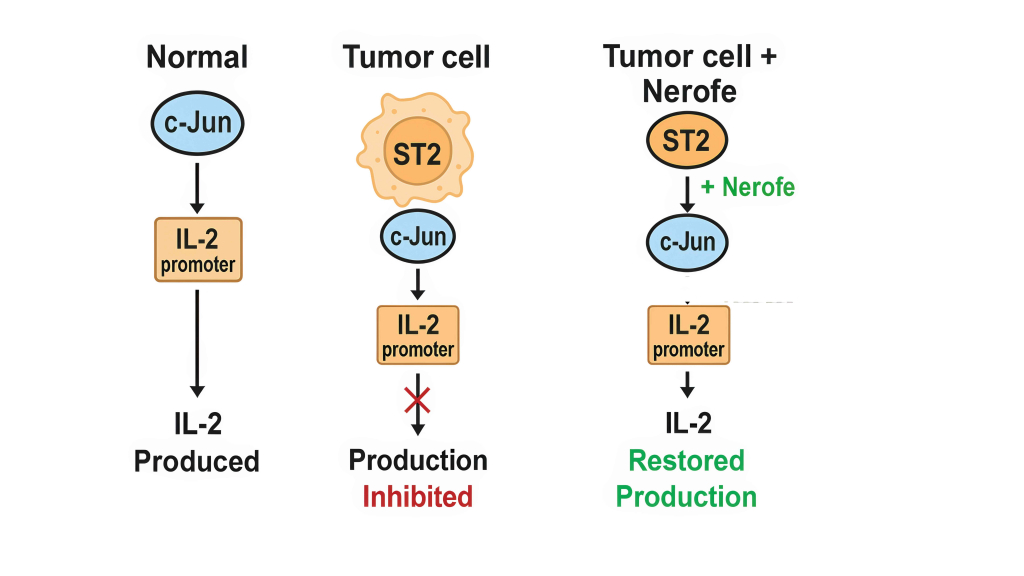
Figure: Restoration of IL-2 expression by Nerofe in ST2-positive tumor cells.